

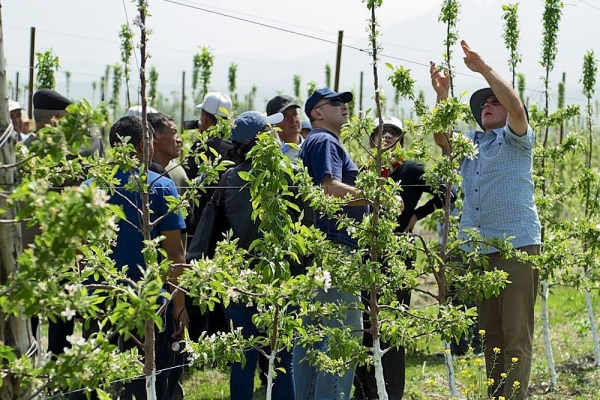
3 Reasons to Invest in Locally-Owned, Sustainable Work
Did you know that local ownership is one of the goals that IDEAS projects work towards? Training local practitioners to own a project that meets the holistic needs of their community takes patience and time but leads to long-term sustainability and transformation.

Corbett and Fikkert share in their book "When Helping Hurts" how easy it is to offer well-intentioned, short-term solutions:
"Wanting to assist a village in Columbia with its rice production, a non-profit organization gathered the villages into a cooperative and bought them a thresher, a motorized huller, a generator, and a tractor. Rice production boomed, and the cooperative sold the rice at the highest price the farmers had ever received. The project appeared to be a tremendous success. The nonprofit organization then left the village, but several years later one of its staff members returned to find that the cooperative had completely disbanded and that all of the equipment was broken down and rusting away in the fields. In fact, some of the equipment had never been used at all."*
Unfortunately, this story has been repeated far too many times in well-intentioned efforts to bring transformation to communities. Over the years, development organizations like IDEAS have learned and adopted new ways of work.
One of IDEAS' success measures is to see movement of a project towards locally-owned, sustainable work. This investment is complex and takes much longer to accomplish but provides many benefits to the community.
Here are 3 reasons to invest in locally-owned, sustainable work:
- Effective Transformation. The most effective transformation comes from within the community, not from outsiders. Members of the community know the real needs of the community. They also know best what resources they have available, what values the community holds, and how best to honor those values. Tapping into this knowledge is critical for effective work.
- Lasting Impact. Transformation of a community requires multiple generations before it becomes lasting hope. The human tendency, as we all know and have experienced, is to fall back into old behaviors. Values are even harder to change. Transformational work must be designed to last far beyond the life of any one person. The desire is for the transformational impact to be sustained and replicated in the community. For this to be true, we must look forward across multiple generations.
- Restored Dignity. Locally-owned sustainable projects honor and respect the individuals in the community. Intellectual growth comes by learning how to do the work. Dignity within the community is restored as a trained person can replicate these skills to their friends and neighbors. As skills are increased in a community, economic benefits typically follow. When all these areas are impacted by hope, the opportunities to engage the community at a spiritual level are multiplied, and the true and lasting hope of the gospel is known and accepted.
If you give someone a fish, you feed them for a day; if you teach someone to fish, you feed them for a lifetime. I would add that if you teach someone to teach others to fish, you can change a community.
*Steve Corbett and Brian Fikkert, "When Helping Hurts" (Chicago: Moody, 2012), 133.
About the Author: Mike is the IDEAS Director of Sector Advocacy and Business Sector Advocate. He has over 30 years business experience, primarily IT related, with experience in financial reporting and business process improvement. Enjoy other blogs by Mike, such as "Sector Advocacy: Multiplying Impact through Professional Projects."
A word from Gabrielle
Why your gift matters
Your gift empowers Reclaim to bring lasting hope and removes barriers so that people around the world can experience the fullness of their God-given dignity!
Together, we can work to provide marginalized individuals and vulnerable communities the opportunity to live flourishing, abundant lives.
Thank you for your partnership!
Above: Tikal, Guatemala
Where we work

PO Box 630027
Littleton, CO 80163
Registered as Desta
EIN: 36-4160878

