

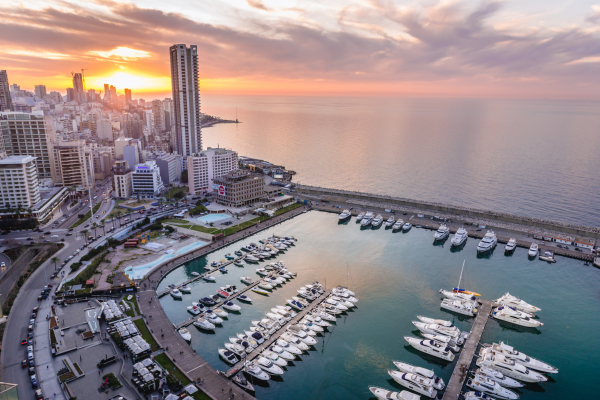
Beirut’s Lighthouse Beams Bright
The Manara Youth Center beams bright in one of Beirut’s poorest and most diverse neighborhoods, which has attracted thousands of refugee families for over 100 years. Manara, which is the Arabic word for “lighthouse,” symbolizes the youth center within this community as a light in the darkness.
Within a two-kilometer square, as many as 400,000 people call this neighborhood home. Nigerians, Sudanese, Palestinians, Lebanese, Iranians, Syrians, and Armenians all live just doors away from each other. Catholics, Evangelicals, Sunni Muslims, Shiite Muslims, and Oriental Orthodox Armenians followers may reside in the same block.
In the middle of the inner city of Beirut, where dim bulbs light what few storefronts are open and power only runs four hours a day, simply having a structure with lights on and open doors is immediately attractive.
Manara Youth Center serves up to 350 teens a week through various social, education, and vocational programs.
The youth center’s first draw is the recreational activities, including board games, video games, and other group interests. Focusing on social activities in a diverse community brings out the youth.
“We want the youth to find rest and feel comfortable,” said IDEAS Associate, David, who helps run the center. “Some just stop in for clean water, heat or air conditioning, and a Wi-Fi signal.”
One of the more visible ways the center serves the community is through education. Most of the poorer families cannot afford a private education. And those who get public education are often in huge classes with limited schedules because of the influx of refugees and a growing population.
These days, Syrian families are the most impacted. Often viewed as outsiders, uninvited guests in this country, the already strained educational resources aren’t always available. And so, the center gives classes that enhance the educational system, teaching Arabic, English, and computer skills. They also offer Bible classes and discipleship courses.
“We show the kids how to build safe relationships. We show them love.”
The psychosocial program at Manara focuses on developing the well-being of the students through individual or group counseling and coaching.
The greatest need right now are the Syrian teens. “They have been through a lot of trauma and displacement in their lives, and the uncertainty in their homes naturally impacts the children in various ways,” said one of the leaders.
“Here they find refreshment and love, but at the end of the day they have to go home. So we want to give them the tools to be better humans and successfully deal with their situations. Teenagers here must think about war and economic stress every single day. Our job is to support them and show them love.”
The reconciliation program is one of the more distinctive – and effective – offerings, and it’s designed to help the youth rethink conflict.
In this uniquely bold program, Manara takes teens in groups of 8 to 10, selected from different ethnic and religious backgrounds. Meeting weekly, the reconciliation program takes on what few achieve – creating peace. The conflict resolution classes currently have 168 individuals.
The small groups start with a meal to discuss topics like forgiveness, love, commitment, and conflict.
“We ask hard questions to help the teenagers work through the resolution,” said David.
At the end of the 10 weeks, each group creates a community project - a visible demonstration of how this Christian love works to improve the world.
“We now see youth giving back,” said IDEAS Associate, Carla. “They're investing in others through discipleship and attending churches. They’re becoming the next generation of leaders, and that's very gratifying.”
An associated program of Manara Youth Center focuses on transitional training geared toward those students who age out of the 18-year-old limit of the youth center.
The vocational training program was born to help the youth further develop into adulthood and transition into full-time work.
The first skills training program was carpentry.
“We looked around the neighborhood, and we saw a need that we could meet,” said David.
The program starts with the basics, ruler measurements and angles, and the next step is building a product they can take home, like stools, benches, and tables.
As the students refine their skills, they produce products that can be sold to the general public. Now the program has advanced enough carpenters that they're looking for mentoring opportunities outside the center.
“We’re looking for more opportunities to create and sell products to give them a sense of accomplishment,” said David.
The vocational training program has grown to offer multiple English, computer, and sewing classes, and 120 students are now in the program.
Aishaa, who is 20 years old, beams at the opportunities ahead. “Now I can work and sew, and this is something that I love to do.”
Other centers around Beirut provide language studies or other vocational offerings, but this one at Manara is distinctive. “Our programs are free,” said David. Most students are Syrians since their needs are most acute right now, considering the ongoing civil war crisis and a lack of educational and work opportunities for most refugees. “They are the ones who have the most need right now.”
A real boon to the program has been offering life coaching. During these sessions, they teach work ethics, personal development, time management, and spiritual values.
Three girls currently in the program are equally optimistic about the impact.
One 17-year-old named Amina said she came to the center three years ago, looking for friends. “But since then, I’ve found better social skills and learned about reconciliation as well as myself.”
Amina also appreciates the life coaching. “It allows me to think before acting and gives me confidence.”
Tamam is 19 and has been with the program since the beginning and is now an assistant in many programs since she is an older teen. She helps with Bible study and games and is a leader for the younger children. Taman believes that the skills she is learning will make her marketable and able to land a good job.
She beamed, “This is a big opportunity to continue my education. It has given me new life. I had lost hope in learning, but they gave me a home to keep learning. Most of all, I’ve learned how to give love towards others.”
Author’s Bio: David Rupert is an IDEAS Associate and a Colorado-based writer who focuses on transformational, inspirational and impact storytelling. Click here for more stories of transformational love.
A word from Gabrielle
Why your gift matters
Your gift empowers Reclaim to bring lasting hope and removes barriers so that people around the world can experience the fullness of their God-given dignity!
Together, we can work to provide marginalized individuals and vulnerable communities the opportunity to live flourishing, abundant lives.
Thank you for your partnership!
Above: Tikal, Guatemala
Where we work

PO Box 630027
Littleton, CO 80163
Registered as Desta
EIN: 36-4160878

