

Old Scars and New Wounds: Christians Comfort Lebanon's Trauma (Part 1)
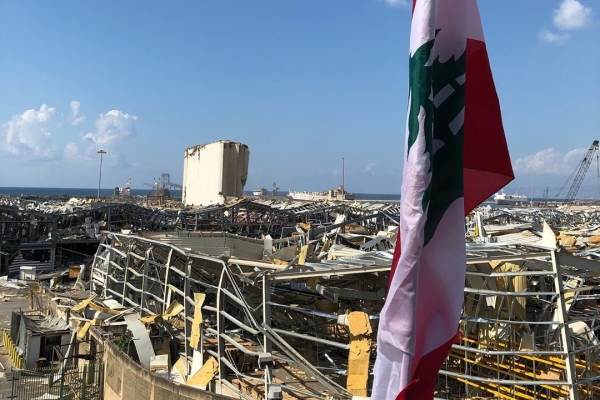
(More than two months since the Beirut blast, emotional support comes from evangelicals, refugees, children and other unexpected sources. An IDEAS Associate living in Beirut, Lebanon shares an article he wrote for Christianity Today on September 9th, 2020.)
 To a traumatized child, a teddy bear can make a big difference.
But as the handful of Lebanese evangelicals trained in counseling are emphasizing in the aftermath of the Beirut explosion, so can an ordinary individual.
"I don't think the sit-with-a-psychologist model works with a communal culture," said Kate Mayhew, country representative for the Mennonite Central Committee (MCC) in Lebanon.
"A lay person might be fearful of doing harm. But there is a lot they can do."
There is a lot that needs to be done.
An assessment conducted in the worst affected neighborhoods of Beirut found that 3 in 4 respondents were suffering anxiety two weeks after the blast.
Nearly 7 in 10 were experiencing disturbing dreams, and 6 in 10 reported difficulty doing household chores.
According to UNICEF, 50 percent of its respondents said their children were showing signs of trauma and extreme stress.
In the poverty-stricken Karantina district directly in front of the port, one child clutched a bag of distributed bread to his chest, rocking back and forth. Though by then such food was readily available, he was imitating the adults who fought and scrambled to grab their share in the first chaotic days of emergency response.
"He was the hungry kid, the frightened kid, and the active kid all combined in one," said Mayhew. "He desperately wanted to show his parents he could also provide for his family."
An MCC partner organization was already on the scene, having set up a mobile clinic and counseling sessions for the adults. Eventually they noticed the kids milling around, otherwise neglected by everyone.
So they created a camp-like setting in the neighborhood park. Rotating 40 children between eight stations, they played games, danced to music, and did artwork,activities experts say are essential for the emotional and spiritual processing of trauma.
And then each kid got a teddy bear.
"These kids are definitely traumatized, and lost so many of their toys," said Joy El Kazzi, child protection officer for MCC. "It was great to see them able to smile." But as a Lebanese, Kazzi was in the minority.
Most of MCC's first responders were Syrians,refugees from war who experienced trauma themselves.
Long committed to psychological service, in 2012 MCC refocused its trauma training on Syrian refugees. After the explosion, the Syrians were prepared to help this new wound of their hosts.
But many Beirut residents were not ready to receive it,from anybody.
Evangelical churches and ministries were among the thousands of Lebanese volunteers who pitched in to sweep shattered glass, repair windows, and offer food to the broken city.
But as Anthony Ziade of City Bible Church conducted over 50 needs assessments in the immediate vicinity of his downtown congregation, only three people ticked the box for counseling.
"If you see a psychologist, it means you are sick," he said. "No one will do that; it is the reality here."
There is no similar stigma about receiving charity,Ziade agreed with 25 households to cover their basic repairs.
It is an honor and shame society, explained Smyrna Khalaf, a licensed marriage and family counselor and a professor at Arab Baptist Theological Seminary.
"Lebanese, especially men, want to look like they can handle things," she said. "Women are less reluctant to admit their weaknesses, and seek help."
But there is another factor involved, peculiar to Lebanon, said Celia Khater, chief counselor at Beirut Baptist School (BBS).
Lebanese pride themselves on their resilience.
Since 1955, BBS has emphasized both mind and spirit, so there is a greater appreciation for psychology among the 1,000 students and their parents. But when her team of three counselors reached out to the families to offer support, only a dozen or so responded.
Generation after generation of Lebanese have experienced war. And since October 2019, they have endured a popular uprising, the COVID-19 crisis, and economic collapse.
And now the explosion.
"Stability is the most important thing in the lives of children, but this year we didn't even have one week of it," Khater said.
"I expected more calls, but the Lebanese culture says 'Khalas [enough], we can manage.'"
Given that 1 in 4 Lebanese have or have had a mental disorder, they do amazingly well.
"People are managing now, but scientifically the long-term impact starts one month later," said Mia Atoui, co-founder of Embrace, a secular organization dedicated to raising awareness of mental health issues in Lebanon.
"Symptoms will fade for many, but hundreds will need ongoing psychological support."
Including their children. Those who suffer an adverse traumatic experience in Lebanon are eight times more likely to develop a mental disorder as adults.
Khater is counseling one BBS preschooler constantly breaking all his toys. Pressed for the reason, he responds with two words: "The explosion."
"I wish we had a well-trained team of Christian counselors, ready to help in times of trauma, whose names are known," she said.
"The secular world has its own organizations, but we as a Christian community do not."
The above statistics were compiled by IDRAAC, the Beirut-based secular organization founded in 1997 as the first mental health initiative in the Arab world.
After the explosion it opened a hotline, as did the American University in Beirut Medical Center. Embrace has operated an emotional support and suicide prevention hotline since 2017, in cooperation with the Ministry of Public Health. Such groups prioritize public awareness campaigns, to remove the mental health taboo from society.
"The priority for the church is to preach Christ," said Tony Skaff, pastor of Badaro Baptist Church, who believes the techniques of psychology can be helpful though they will fall short of full healing, without the gospel.
"But these secular organizations push me. I wish that we could have helped them first."
Unaware to many, there is a Christian ministry on standby. . .
(Stay tuned for part 2 of this blog post next Monday, October 26th!)
*This post is an excerpt from the original that was written and posted for Christianity Today on September 9, 2020. Click here for the original article.
About the Author: Jayson and his family are IDEAS Associates who have lived in the North Africa/Middle East region for 15 years. Click here to read other stories and articles from Jayson's work as a journalist with Christianity Today.
A word from Gabrielle
Why your gift matters
Your gift empowers Reclaim to bring lasting hope and removes barriers so that people around the world can experience the fullness of their God-given dignity!
Together, we can work to provide marginalized individuals and vulnerable communities the opportunity to live flourishing, abundant lives.
Thank you for your partnership!
Above: Tikal, Guatemala
Where we work

PO Box 630027
Littleton, CO 80163
Registered as Desta
EIN: 36-4160878

