
Stronger Than I Look
If I asked you to envision the strongest person you know, what would that person look like?
My concept of what strength looks like was recently challenged by a visit to a group of our project beneficiaries in the south of Tunisia. The young adults in the group are part of an advocacy network for people with physical disabilities.
With erratic sidewalks and no curb cuts, life is not easy for people in Tunisia with limited mobility. People using wheelchairs often have to rely on the help of those passing by to be lifted on or off curbs, buses, and trains. Even businesses that claim to be accessible rarely are—with ramps too steep for wheelchairs to mount them, or steps to the bathrooms.
Most members of the advocacy group were unable to attend traditional schooling because their local schools were not accessible to people with limited mobility. They’ve all been told by their families and neighbors that they will never be truly happy in life because they will never experience marriage or parenthood—not because they are physically or legally unable, but because the society in which they live doesn’t consider them capable or desirable.
This group of young people participated in a series of trainings offered by one of our partners in the region to help people with disabilities build their sense of autonomy, self-worth, and self-confidence. The project also encouraged these young people to develop an online network for mutual support and advocacy.
One member, Khadija,* told me that the difference between who she is now and who she was before joining this group is like the difference between day and night.
Khadija shared that for the first 20 years of her life she almost never left her home or said more than ‘hello’ and ‘goodbye’ to people because she was so ashamed of her cerebral palsy.
“I never talked. Never. Now, you can’t get me to stop talking!” she said while laughing and surrounded by her friends and co-advocates.
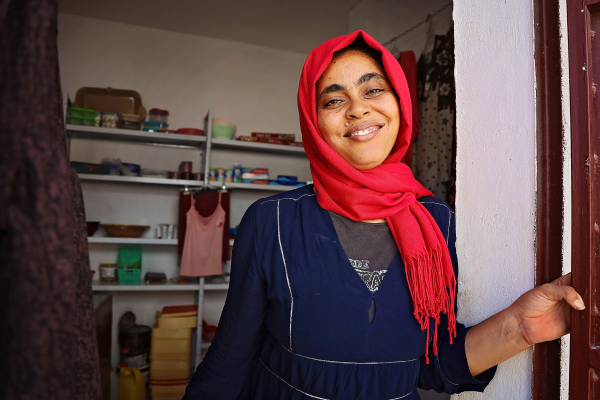
Through the confidence and training she gained by participating in our partner’s projects she has become a small business owner, running a convenience store out of an annex built on to her family’s home.
With tears welling up in her eyes, Khadija told me that she now sees it as her mission in life to make sure that no other children lose so many years of their life to shame. Then she immediately started telling me about a young boy she knows who is blind, and her desire to see him and his family connected to supportive services as soon as possible.
Then she pitched me on services she hopes to provide as a consultant to some of our other projects. I smiled as I realized that Khadija has become a force to be reckoned with!
Our projects with people with disabilities are designed not only to help people get jobs and increase accessibility, but also to intentionally challenge worldviews that treat people with disabilities as unworthy of love, dignity, or inclusion.
By living out our belief that all people are “fearfully and wonderfully made” in the image of a great God, our project staff seek to inspire change in individual hearts and in the society as a whole.
Sitting in awe across the table from this inspiring group of young people, I was reminded how God’s power is often most evident in places where the world only sees weakness.
This group is stronger than they look, and I am excited to see the change that they will bring about through their collective passion and efforts.
*Khadija's name has been changed out of respect for confidentiality.
Click Here to Give Hope Today!
About the Author: Julia is an IDEAS Associate and moved to Tunisia in 2021. She oversees community needs assessments, project development and implementation, local partner relationships, and impact measurement for an IDEAS partnering project. Enjoy other blogs by Julia, such as "I (am learning to) Delight in Weakness."
Click here to support Julia and her work in Tunisia.
A word from Gabrielle
Why your gift matters
Your gift empowers Reclaim to bring lasting hope and removes barriers so that people around the world can experience the fullness of their God-given dignity!
Together, we can work to provide marginalized individuals and vulnerable communities the opportunity to live flourishing, abundant lives.
Thank you for your partnership!
Above: Tikal, Guatemala
Where we work

PO Box 630027
Littleton, CO 80163
Registered as Desta
EIN: 36-4160878

